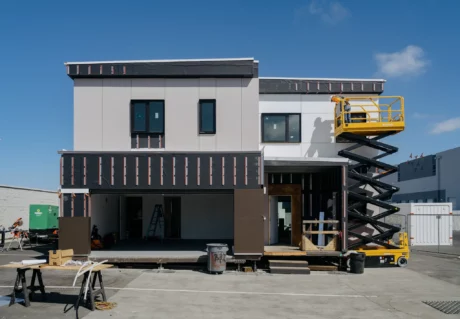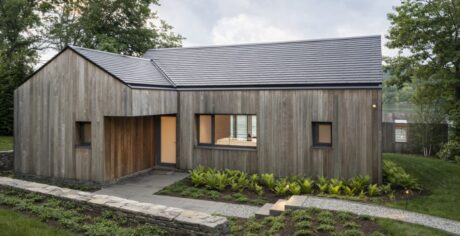
The City of New York (the “City”) plays a powerful role in paving the way to decarbonize the built environment and scale the clean construction industry by enabling innovative solutions, facilitating bold policies, and operating pilot programs to overcome implementation challenges in tangible ways. As part of the City’s decarbonization efforts, New York City Economic Development Corporation ("NYCEDC") is launching the New York City Mass Timber Studio (the “NYC Mass Timber…
Passive House Designer / Consultant course
Happening: Oct. 12th – Dec. 15th Learn first-hand from experts at the Passive House Institute, how to design energy-efficient & cost-optimal buildings worldwide! A prerequisite is a general knowledge of Passive House, which you can conveniently acquire via the approx. 3-day e-learning Passive House Fundamentals: https://elearning.passivehouse.com You also need a good level of English (B2 or equivalent), basic knowledge of building physics, as well as the ability to use Microsoft® Excel. E-learning "Passive…
The New York Times: As the Climate Changes, Pressure Is Growing to Make Buildings More Efficient
Charlotte the child is active: running, playing, giggling while she rides her bike. But her namesake, Charlotte the condo building, is passive. Its airtight rooms use a fraction of the energy required by the buildings around it, staying cool in the summer and warm in the winter, while light-soaked and quiet. Buildings account for nearly 40 percent of global carbon dioxide emissions, and on a rapidly warming planet, the pressure…
Expanding the Cross-Learning Alliance
We’re proud to be joining the Cross-Learning Alliance! Created in 2018, the Alliance brings cutting-edge events that promote dialogue and information-sharing among the people who own, design, build, manage and operate buildings. Founding members include Urban Green, AIA New York and ASHRAE New York Chapter. Learn More
New Products -475 High Performance Building Supply
There are easy and cost-effective actions that can be taken now
Carbon emissions from the materials used to construct buildings is a major global emissions source but is not yet part of many official calculations to decarbonize buildings. Current and historic efforts have focused primarily on reducing operational energy use – the emissions from the burning of fossil fuels at the buildings – or to produce electricity to power homes and businesses. Yet there are easy and cost-effective actions that can…
Concrete Innovations Winner: Pozzotive® Ground Glass Pozzolan
Innovative Product or Service The Connecticut Ready Mixed Concrete Association (CRMCA) nominates Pozzotive®, a ground glass pozzolan (GGP) manufactured by Urban Mining Industries (UMI), for the contribution it makes to our industry from both an environmental and performance perspective. O&G Industries, a CRMCA & NRMCA member, has also been actively involved in the manufacturing and use of this important new pozzolan. UMI, in a joint venture with an O&G affiliate,…

Passive House Podcast Ep 34: Beverly Craig, MassCEC
In Episode 34 of the Passive House Podcast, cohost Zack Semke interviews Passive House policy leader and accelerator Beverly Craig, Senior Project Manager of Low and Moderate Income Programs at Massachusetts Clean Energy Center (Mass CEC). Zack and Beverly discuss the pivotal role that policy progress can play in spurring widespread adoption of Passive House design and construction. Beverly shares her firsthand experience instigating rapid Passive House uptake in her state, spurred along by programs like…
Workshop: Honeybee-PH Plugin for Passive House Modeling
Hello Ladybug Tools community, I am excited to let everyone know that we are ready to share the first public version of the new Honeybee-PH v1.0 plugin for Ladybug Tools. This new LBT plugin is designed to make it easy to utilize LBT models for Passive House design and certification to both the International PHI standard and the US Phius standard. This new plugin replaces the older LBT2PH , and has…
Why Does Embodied Carbon Matter for MEP?
Buildings generate the most global carbon emissions annually. Energy use makes up ~30% of annual global greenhouse gas emissions, while embodied carbon adds up to ~10%. Architecture 2030 challenges architects to design more energy efficient buildings, but the impacts of the systems installed can be significant. Mechanical equipment, delivery, refrigerants, and refrigerant leaks are commonly excluded from life-cycle analysis studies, so we don’t know the full extent of their impacts.…
Minimizing Spray Foam with Flash and Batt Strategy
Spray foam has become one of the most widely used insulation materials in the construction industry since it was invented in the 1980s. There are a number of reasons why spray foam has become a popular choice for both residential and commercial insulation applications. First, it can be installed quickly. Second, it completely fills cavities and is able to be sprayed around wiring and plumbing. Third, it has an effective…
Case Study: All-Wood, All the Time by OPAL Architecture
For Matthew O’Malia and his firm OPAL Architecture, each design opportunity is not just a creative exercise, it’s also a potential manifesto. The question of where to build is answered by the custom client, but what remains in play is what to build and how to build it. Indeed, how should we build is a conundrum that’s dogged and excited Matt for years, ever since he partnered with builder Alan…